Neuron structure and the nerve impulse
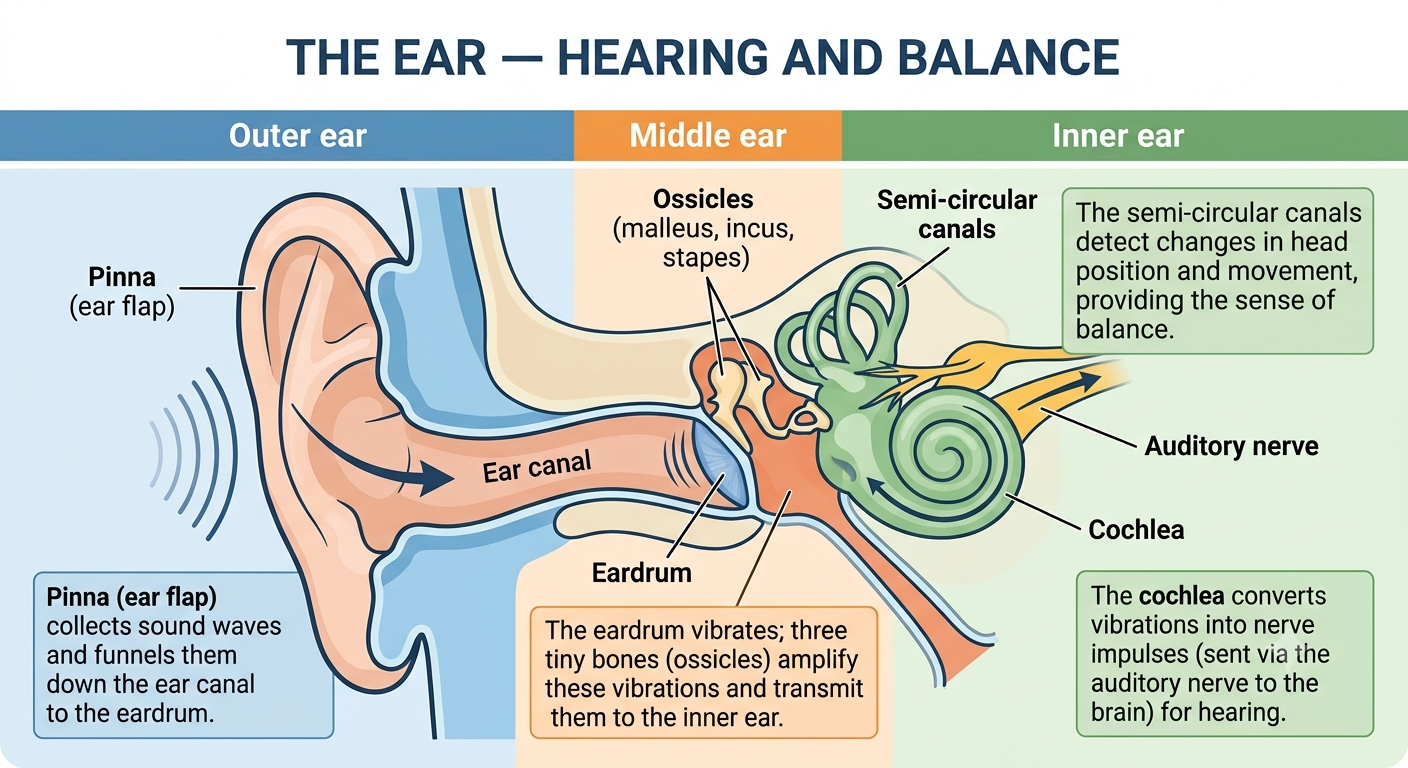
A neuron (nerve cell) is the basic functional unit of the nervous system, adapted to carry electrical impulses rapidly around the body. Its main parts are:
- Dendrites — branching extensions that receive impulses from other neurons and carry them toward the cell body.
- Cell body — contains the nucleus and most organelles.
- Axon — a long fibre that carries the impulse away from the cell body toward the next neuron or an effector (muscle or gland).
- Synapse — the small gap between the axon of one neuron and the dendrite of the next. When an impulse arrives, chemicals called neurotransmitters are released, diffuse across the gap, and trigger a new impulse in the next neuron.
Organisation of the nervous system
The human nervous system is divided into two main parts:
- Central nervous system (CNS) — the brain and spinal cord; this is where information is processed and responses are coordinated.
- Peripheral nervous system (PNS) — all the nerves that branch out from the CNS to the rest of the body, carrying impulses to and from the CNS.
The reflex arc
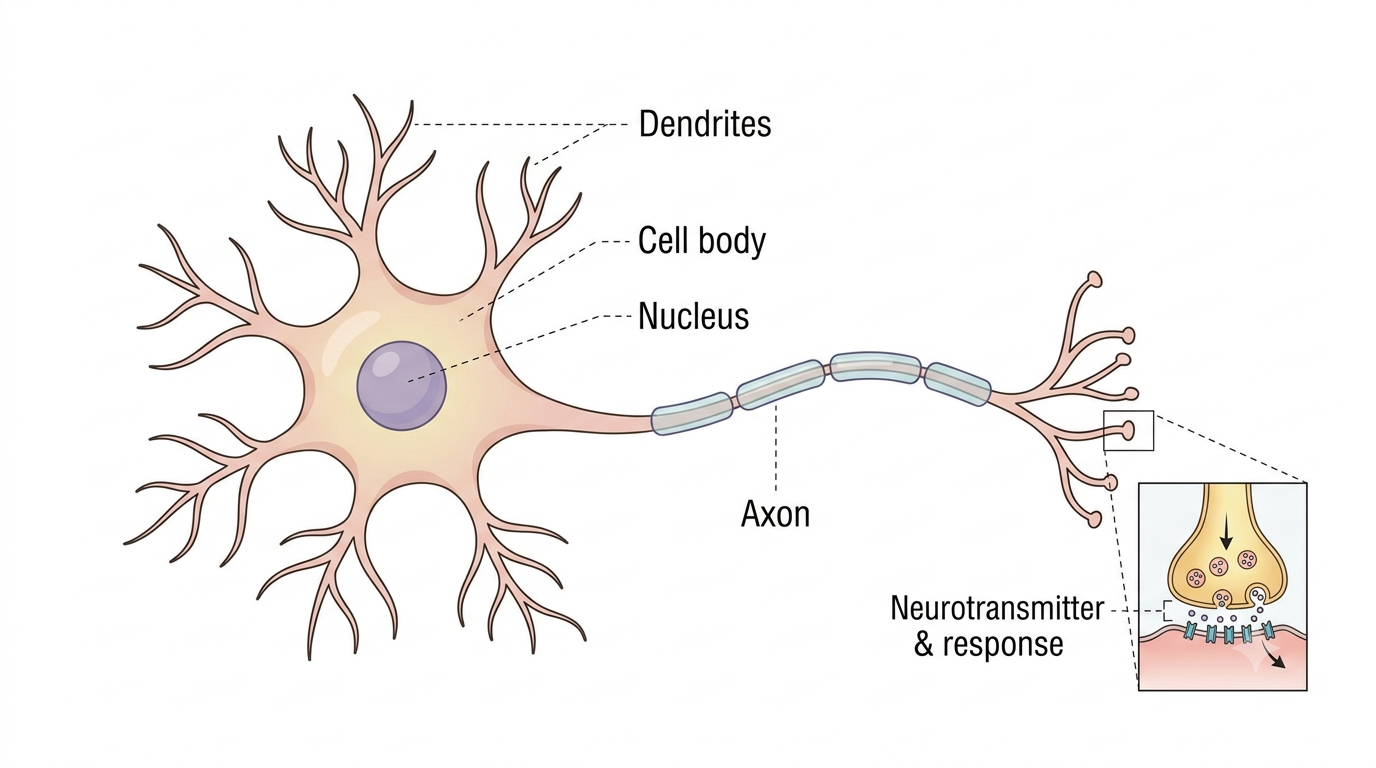
A reflex action is a fast, automatic, involuntary response to a stimulus that does not require conscious thought — for example, pulling your hand away from something hot. The pathway an impulse follows is called a reflex arc:
Because the impulse can bypass the brain (being processed at the spinal cord instead), reflexes are much faster than responses that require conscious decision-making.
The eye — structure and the pathway of light
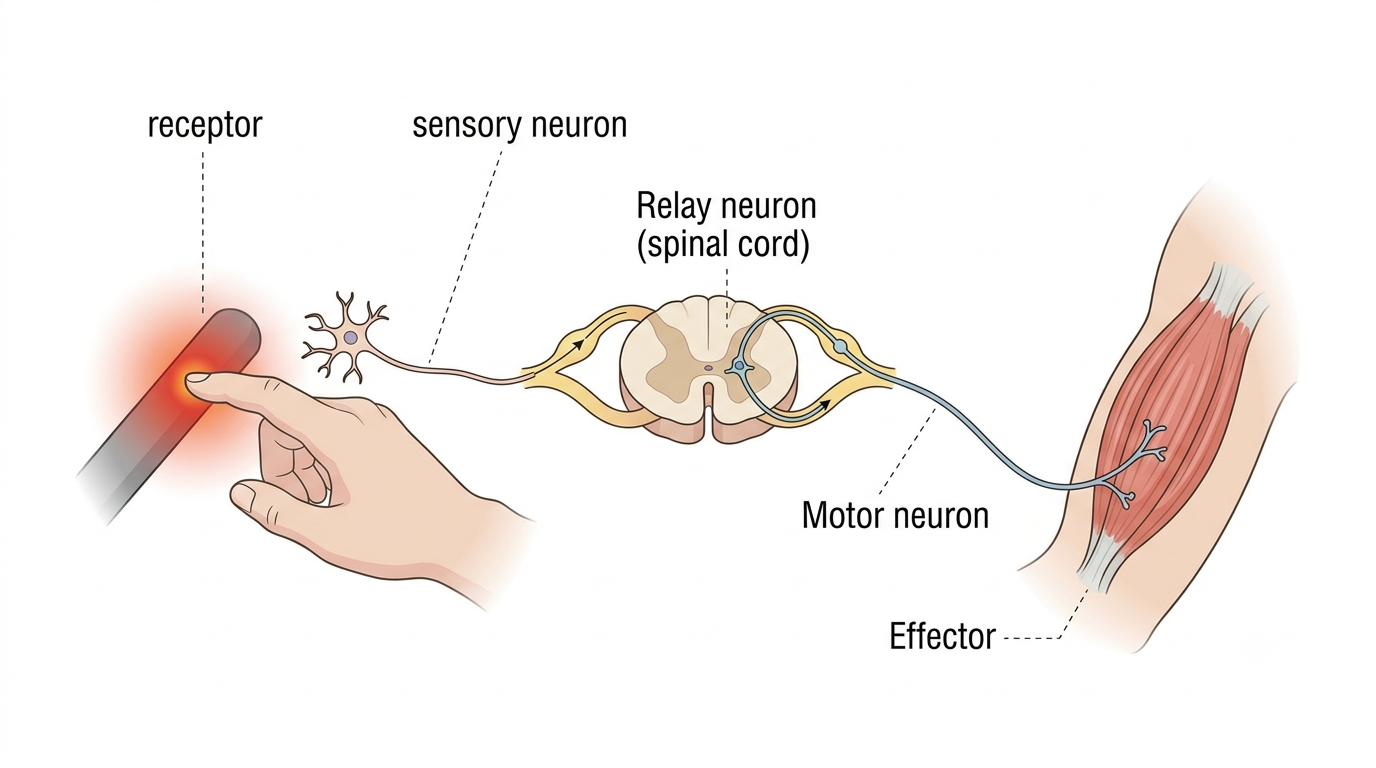
The eye detects light and converts it into nerve impulses that the brain interprets as sight:
- Cornea — the transparent front layer that does most of the initial bending (refraction) of light entering the eye.
- Lens — fine-tunes the focus, bending light further so it falls precisely on the retina.
- Retina — the light-sensitive layer at the back of the eye, containing receptor cells (rods and cones) that convert light into nerve impulses.
- Optic nerve — carries these impulses from the retina to the brain for interpretation.
Accommodation — how the eye focuses
Accommodation is the eye's ability to change the shape (convexity) of the lens so that both distant and near objects can be focused clearly onto the retina. The ciliary muscles and suspensory ligaments work together to do this:
| Structure/change | Focusing on a DISTANT object | Focusing on a NEAR object |
|---|---|---|
| Ciliary muscles | Relax | Contract |
| Suspensory ligaments | Become taut (tension increases) | Slacken (tension decreases) |
| Lens shape | Becomes less convex (thinner, flatter) | Becomes more convex (rounder) |
| Light refraction | Refracted less | Refracted more |
The ear — hearing and balance
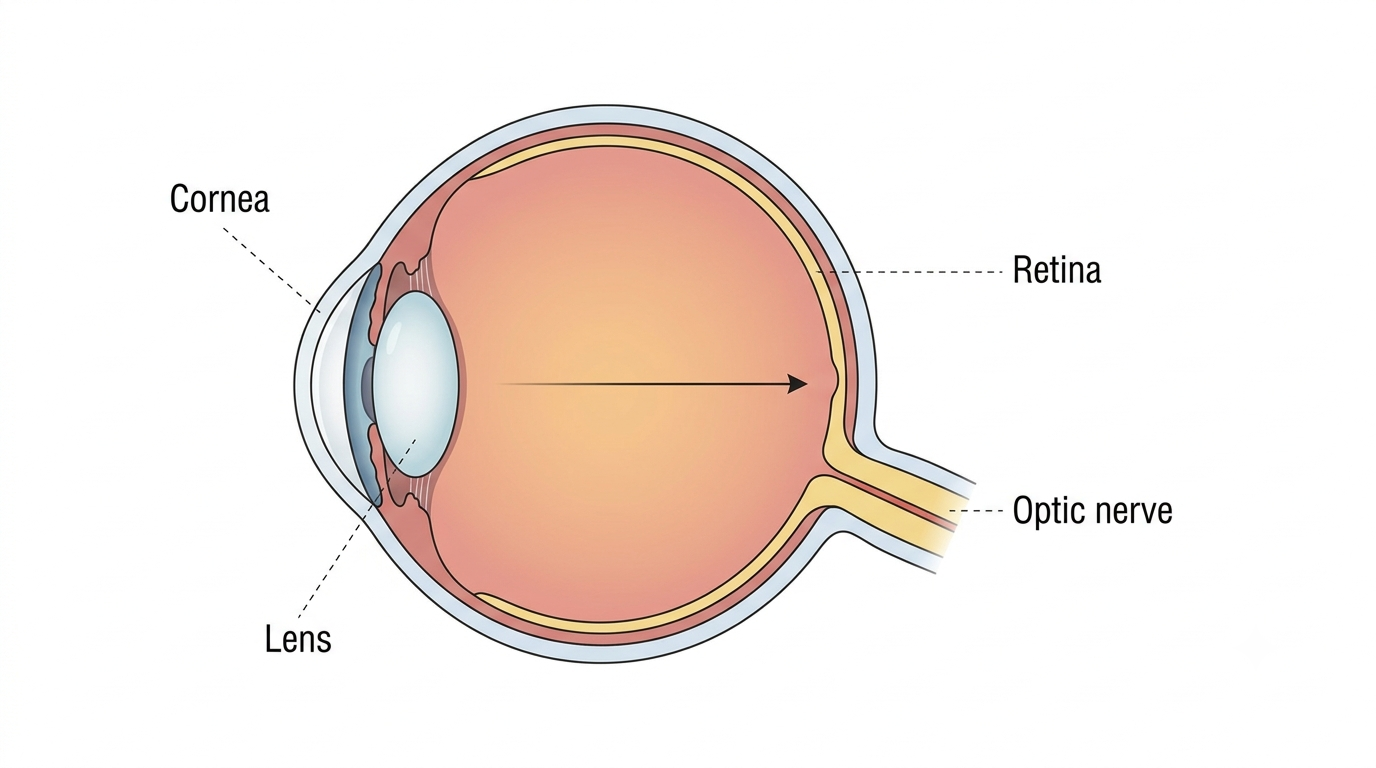
The ear has three regions, each playing a different role:
| Region | Key structures & function |
|---|---|
| Outer ear | Pinna (ear flap) collects sound waves and funnels them down the ear canal to the eardrum. |
| Middle ear | The eardrum vibrates; three tiny bones (ossicles) amplify these vibrations and transmit them to the inner ear. |
| Inner ear | The cochlea converts vibrations into nerve impulses (sent via the auditory nerve to the brain) for hearing. The semi-circular canals detect changes in head position and movement, providing the sense of balance. |